What We Are Reading 2025
What started as a simple question—What’s the last good book you read?—has become a favorite annual tradition. This year’s faculty picks are diverse, spanning genres, eras, and ideas. Whether rooted in law, history, fiction, or beyond, each recommendation offers a window into what’s been capturing our faculty’s curiosity.
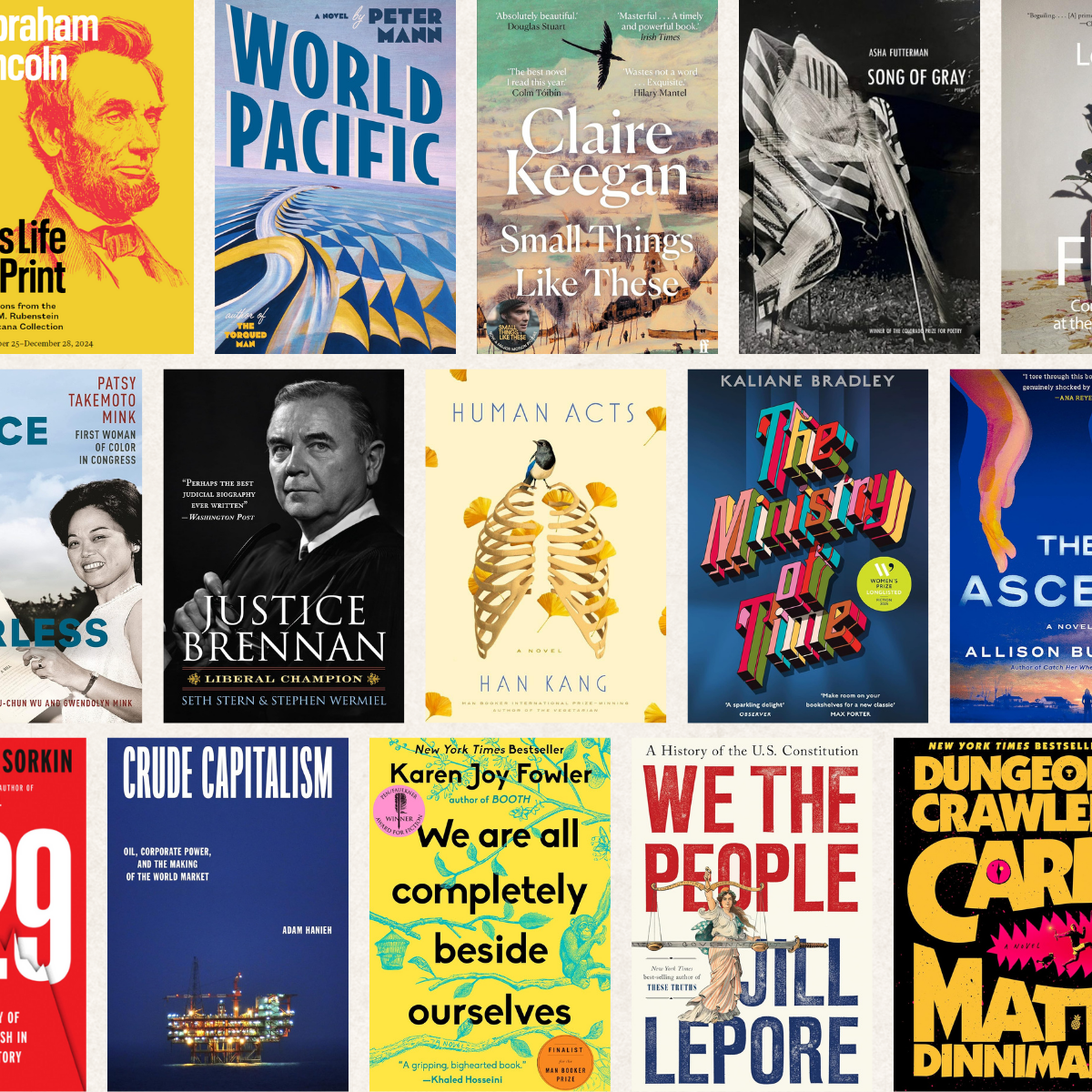
Carbon Hunters by Paula DiPerna and Richard Sandor
Recommended by Adam Chilton, Dean, Howard G. Krane Professor of Law, Walter Mander Research Scholar

"Carbon Hunters tells the inspiring story of the visionary leaders who turned bold academic ideas into market solutions that have helped reduce emissions and protect the environment. It also offers a clear blueprint for how financial innovation and global cooperation can be harnessed to build a sustainable future. Anyone who cares about the importance of ideas, the power of markets, or saving the planet should view this book as required reading."
Doing Meritocracy Right: How Business Leaders Can Turn an American Aspiration into Reality (and Why They Should) by Thomas A. Cole, '75
Recommended by Adam Chilton, Dean, Howard G. Krane Professor of Law, Walter Mander Research Scholar

"Doing Meritocracy Right offers a powerful defense of meritocracy in American companies and institutions—while urging a rethinking of what meritocracy truly means. The book provides a nuanced and engaging account of the challenges leaders face when designing systems that reward merit, drawing on examples from professional service firms that have found thoughtful ways to promote both excellence and opportunity. Particularly compelling is its call for humility from those who have benefited from meritocratic systems in their educational and professional lives. This is a thought-provoking and timely work that anyone involved in institutional design and decision-making should read and reflect upon."
Abraham Lincoln: His Life in Print by David M. Rubenstein, '73
Recommended by Adam Chilton, Dean, Howard G. Krane Professor of Law, Walter Mander Research Scholar

"This is a beautifully designed book that tells the story of Lincoln’s life through the printed materials that influenced his thinking. The book highlights over 300 historical prints that are part of David Rubenstein’s private collection, as well as including twelve essays written by leading historians, scholars, and experts on Lincoln. The book is exceptionally beautiful and designed in a way that shows off artifacts that would normally be available in a library of rare books or a museum."
The Ascent by Allison Buccola, '11
Recommended by Adam Chilton, Dean, Howard G. Krane Professor of Law, Walter Mander Research Scholar

"This is the latest book by Allison Buccola, '11, who went from practicing law to being a successful novelist. This book is a page turning thriller that tells the story of a young mother who as a child was part of a reclusive cult where all of her family and the other members disappeared."
Vision: A Memoir of Blindness and Justice by David S. Tatel, '66
Recommended by Albert W. Alschuler, Julius Kreeger Professor Emeritus of Law and Criminology
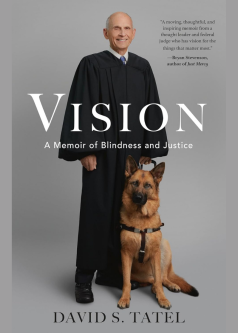
"David Tatel recently retired from the U.S. Court of Appeals for the D.C. Circuit, has been a distinguished civil rights lawyer and a great judge. He is also a University of Chicago Law School alumnus who credits Phil Kurland, Bernie Meltzer, and other mid-1960s faculty members for showing him that law is like natural science with words and political science with rules.
Tatel's deserved criticism of the current Supreme Court is more likely to inform lay readers than savvy lawyers, but lawyers as well as lay readers are certain to be engaged by his account of an exciting and productive career and, particularly, by his description of how he managed and mismanaged his dimming vision and eventual blindness. Tatel is hard on himself for working to conceal his growing disability and for struggling to get by with the least help he required. The story of how, late in life, he learned to work with, depend on, and fall in love with a guide dog named Vixen is moving, and so is the story of his impressive wife Edie (whom he took to a poetry reading at Jimmy’s Woodlawn Tap on their first date)."
The Fate of the Day by Rick Atkinson
Recommended by Douglas Baird, Harry A. Bigelow Distinguished Service Professor of Law

"The second volume of Atkinson’s trilogy on the American Revolution provides an accessible account of the American Revolution, with the military action ranging from Quebec to Georgia. Many interesting characters appear unexpectedly. Pierre-Augustin Caron de Beaumarchais is most remembered today as the playwright who gave us Figaro, but here we are reminded that we as Americans are indebted to him also for his skills as a gun-runner."
The Spy by James Fenimore Cooper
Recommended by Douglas Baird, Harry A. Bigelow Distinguished Service Professor of Law

"Cooper’s reputation never recovered from Mark Twain’s take-down of his prose style, and the novel is in many ways dated, but it has a legitimate claim to being the first American novel. In it, Cooper introduces for the first time the trope of the spy who comes in from the cold. It is also a novel of the American Revolution written when the war was still a living memory and recalled as a civil war. Some of the characters are paper thin and some of the plot turns ridiculous, but the portrayals of Harvey Birch, the archetypal spy, and George Washington are both interesting. If you want to lead a revolution, you must be willing to get your hands a little dirty."
Dungeon Crawler Carl by Matt Dinniman
Recommended by William Baude, Harry Kalven, Jr. Professor of Law, Faculty Director, Constitutional Law Institute

"This year I discovered the 'Dungeon Crawler Carl' series, recently released in seven volumes by Ace Books (with three more to come). The premise is improbable and hard to explain — the main character, along with all of the survivors of an attack on Earth, are caught inside an AI-generated dungeon role playing game that is also a galactically popular reality TV show. The genre ('LitRPG') is odd — part science-fiction, part fantasy, and part fourth-wall-breaking. But the combination is incredible — gripping, shocking, hilarious, and ultimately inspiring."
Listening to the Law by Amy Coney Barrett
Recommended by William Baude, Harry Kalven, Jr. Professor of Law, Faculty Director, Constitutional Law Institute

"An account of the official story of the law and the role of the Supreme Court from one of the best and most important Justices on it — Justice Amy Coney Barrett. Justice Barrett discusses judicial neutrality, originalism, the Dobbs decision and many other controversial matters in an incredibly even and judicious tone. While some of this will be well-known to graduates of the law school, the book adds an important perspective to what you can get from the news and from the Court's opinions. An important read for Justice Barrett's critics and fans alike."
Klara and the Sun by Kazuo Ishiguro
Recommended by Omri Ben-Shahar, Leo and Eileen Herzel Distinguished Service Professor of Law

"A story about an android purchased to provide friendship to an ill teenager, told from the naïve perspective of Klara, the android. The eerie contours, unfolding endlessly in every page, are in fact not due to the robotic technology. In fact, Klara and her supernatural capabilities, along with her misconceptions and inhumanity, provides endless heartwarming moments. It is humanity—the adults in the story—with their emotional paralysis and chilling alienation, that expose a society of indignity, decay, and discrimination. The book turns on its head the standard insight of Einstein’s famous remark – 'it has become appallingly obvious that our technology has surpassed our humanity.'"
We Are All Completely Beside Ourselves by Karen Jay Fowler
Recommended by Omri Ben-Shahar, Leo and Eileen Herzel Distinguished Service Professor of Law
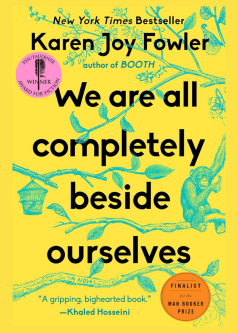
"If I tell what this book is about, I will spoil the first quarter of it. An incredible (and sad) story—amazing plot!—about family and betrayal, commenting along the way on the realism and dogmatism of academic sciences. Brilliant prose that sent me looking for more books by Fowler."
1929 by Aaron Ross Sorkin
Recommended by William A. Birdthistle, Professor from Practice
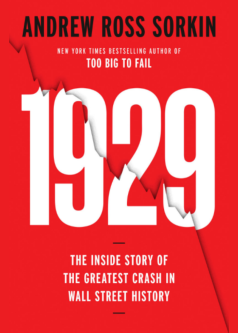
"Sorkin's previous account of a financial collapse was his Too Big To Fail, which covered the 2008 Great Financial Crisis in minute-by-minute detail. Alas, he was not present in 1929 to sift the primary sources first-hand, but this history is still an intriguing account. What may be most notable is his shift from the descriptive to the predictive and his choice to publish urgent warnings about the vitality of American finance right now: he is deeply concerned today about the unlearned lessons from an overheated stock market a century ago."
Democracy and Solidarity by James Davison Hunter
Recommended by Samuel Bray, Professor of Law

"Democracy and Solidarity, published in 2024, is about what ails politics in the United States. James Davison Hunter argues that contemporary American society has seen a dissolution of the cultural preconditions for democratic persuasion. The result has been a replacement of solidarity and persuasion with a politics of identity and ressentiment (on both left and the right). Details can be disputed, but the broad sweep of Hunter's argument is timely and sobering—even grim."
What We Can Know by Ian McEwan
Recommended by Samuel Bray, Professor of Law and Alison Siegler, Lillian E. Kraemer Clinical Professor in Public Interest Law, Director of the Federal Criminal Justice Clinic

Bray: "What do we really know about the people and events that have come before us? That question is at the heart of Ian McEwan’s gently paced but brilliantly perceptive new novel What We Can Know (I listened to the audio version by Rintoul & Bavidge). The novel is set in the early twenty-second century, and it involves an English professor or two attempting to figure out what really happened at a dinner party in 2014, a 'Second Immortal Dinner' where a great poet read a corona dedicated to his wife. The story is laced with foreboding and fulfillment, with guilt and betrayal. Deftly but insistently, McEwan forces the reader to consider how a future generation, a century from now, will think about the historical past that we now inhabit."
Siegler: "McEwan’s remarkable new novel answers the implicit question in its title with a resounding 'not much.' A scholar living in a postdiluvian and gently dystopian 2119 has made it his life’s work to find a missing poem written in 2014. 'The imagined lords it over the actual,' with the poem growing in fame as the academy and society project onto it whatever they want it to be. Meanwhile, the mystery around its text and whereabouts deepens. The missing poem highlights a key theme—although so much information about humanity is permanently and irrevocably preserved in the ether, many other aspects of our lives are lost, unknown, and unknowable."
World Pacific by Peter Mann
Recommended by Vince Buccola, Professor of Law

"No one romps like Peter Mann. You know about structural and 'great man' theories of history; Mann practices what one might call the La Mancha theory, which is much more fun. Wit from the sentence level up."
We the People: A History of the U.S. Constitution by Jill Lepore
Recommended by Mary Anne Case, Arnold I. Shure Professor of Law
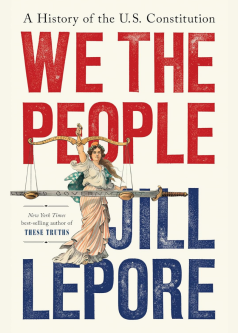
"This is the first recommendation I have only listened to, not read. I put the author's own lively Audible rendition on double speed while commuting and cleaning house. I was expecting a book densely packed with basic general information for the non-expert reader, which the book did provide in an entertaining, accessible way, but I was pleasantly surprised by how much there is in it that could also interest experts."
The Interbellum Constitution by Alison L. LaCroix
Recommended by Sharon R. Fairley, Professor from Practice

"When reading in my spare time, I rarely opt to read more legal content. But, I happily made an exception to read Professor LaCroix’s new book. I really enjoy how she brings the reader deep into the historical era by providing details, stories and anecdotes as context."
Song of Gray by Asha Futterman
Recommended by Craig Futterman, Clinical Professor of Law

"With her deadpan and understated but searing delivery, Asha takes us along on her journey of seemingly simple but multi-layered observations about Black experience that is not starkly Black or White, but that lives in the Gray. I’m amazed by how something can be both so nuanced and strip us bare at the same time. On the one hand, it reads as stream of consciousness. And on the other, it causes us to pause and reflect on insights that pierce deeply beneath the surface. Asha offers a lyrical critique that is both timely and timeless."
And the Roots of Rhythm Remain: A Journey through Global Music by Joe Boyd
Recommended by Tom Ginsburg, Leo Spitz Distinguished Service Professor of International Law, Ludwig and Hilde Wolf Research Scholar, Professor of Political Science, Faculty Director, Malyi Center for the Study of Institutional and Legal Integrity, Faculty Director, Forum for Free Inquiry and Expression

"This is a comprehensive account of the rise of 'world music,' by a legendary music producer who brought us music by REM, Nick Drake, Pink Floyd and many others. Taking its name from Paul Simon’s song 'Under African Skies' from his 1986 Graceland album, the book explores the rise of Zulu jive, Cuban son, Jamaican reggae, Argentinean tango and many other genres. It explores how music from around the world influenced Simon and many other Western musicians, while also circulating fluidly across oceans and borders. Boyd, like me, is a huge Toots Hibbert fan, and I learned a good deal about many musics that I love. Comes linked to its own highly-recommended Spotify list!"
The Origins of Totalitarianism by Hannah Arendt
Recommended by Tom Ginsburg, Leo Spitz Distinguished Service Professor of International Law, Ludwig and Hilde Wolf Research Scholar, Professor of Political Science, Faculty Director, Malyi Center for the Study of Institutional and Legal Integrity, Faculty Director, Forum for Free Inquiry and Expression

"There is never a bad time to re-read this classic, but it is especially thought-provoking now. Not because we are living with the immediate threat of totalitarianism, but because Arendt’s vocabulary and framing give us so many tools to understand the present and how we got here. I am jealous of some of our older alums who had the chance to study with her at Chicago in the 1960s."
Fierce and Fearless: Patsy Takemoto Mink, First Woman of Color in Congress by Judy Tzu-Chun Wu and Gwendolyn Mink
Recommended by William Hubbard, Deputy Dean, Harry N. Wyatt Professor of Law

"One of the Law School’s most distinguished graduates, Patsy Takemoto Mink, recently had a biography published. Fierce and Fearless was co-authored by historian Judy Tzu-Chun Wu and Patsy Mink’s daughter, Gwendolyn Mink. This book is a long-overdue telling of the life of a trailblazing American leader. Born in colonial Hawaii, a society carved along lines of race, gender, citizenship, and education, Patsy Mink defied such categories and pursued a vision of an inclusive, democratic American society. After graduating from Law School in 1951, she began solo practice, and then her political career, after law firms in both Chicago and Honolulu refused to hire her. She served in the Hawaiian territorial legislature, Honolulu city council, and the Carter administration, with her longest and most impactful service as a member of the US House of Representatives from 1965-1977 and again from 1990-2002. An architect of many pieces of legislation, she is best known as the champion of Title IX, the landmark legislation passed in 1972 that expanded educational opportunities for women.
The book not only catalogues Mink’s achievements. It also provides uniquely personal windows into turning points in US history, such as the attack on Pearl Harbor and 9/11. Still, it’s an imperfect book. It verges on hagiography and insists on evaluating events, rather than letting the story speak for itself. This is a shame, because even a gimlet-eyed account of Mink’s life would, no doubt, leave the reader astounded by her character, intellect, and commitment to public service."
Crude Capitalism by Adam Hanieh
Recommended by Aziz Huq, Frank and Bernice J. Greenberg Professor of Law

"Oil, Corporate Power, and the Making of the World Market. Hanieh’s book is an eye-opening, panoramic prehistory of the Anthropocene, brilliantly crystallized. The chapter on petrochemicals’ history — not a topic I’d considered much before — is alone worth the price of admission."
Human Acts by Han Kang
Recommended by Aziz Huq, Frank and Bernice J. Greenberg Professor of Law

"In May 1980, soldiers massacred pro-democracy demonstrators in the university town of Gwangju, South Korea. Kang’s novel spirals out, like a bird on an updraft, from that moment, to explore the extraordinary ways in which memories of death and political violence resist suppression, even as they wreak agony on survivors. A harrowing book that is eclipsed, for better or worse, by Kang’s equally brilliant The Vegetarian, its rich rewards are particularly resonant today."
Against Constitutional Originalism by Jonathan Gienapp
Recommended by Alison L. LaCroix, Robert Newton Reid Professor of Law, Associate Member of the Department of History
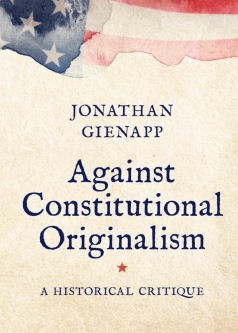
"Jonathan Gienapp’s brilliant first book, The Second Creation, upended much of the received wisdom about how the American founding generation actually put the Constitution into practice in the 1790s. In Against Constitutional Originalism, Gienapp turns his formidable skills as a historian to the modern constitutional interpretive approach of originalism. With rigor and deftness, and an unstinting dedication to the historical method as practiced by historians, Gienapp lays out a comprehensive critique of originalism, concluding that '[t]he Founders’ constitutionalism was not ours.'"
The Cazalet Chronicles by Elizabeth Jane Howard
Recommended by Alison L. LaCroix, Robert Newton Reid Professor of Law, Associate Member of the Department of History

"This five-volume series, beginning with The Light Years and continuing through Marking Time, Confusion, Casting Off, and All Change, captures four generations of an English family from the 1930s through the late 1950s — from the deceptive calm before World War II to the cusp of the 'Swinging Sixties.' Each volume is both a chapter in a saga and also an intensely intimate portrait of a family of individuals, each of whose perspective Howard inhabits with uncanny specificity. A commitment, but well worth it."
The Ministry of Time by Kaliane Bradley
Recommended by Alison L. LaCroix, Robert Newton Reid Professor of Law, Associate Member of the Department of History

"A wildly imaginative and yet deeply human novel of time travel, historical research, and complex interpersonal (and intertemporal) relationships. It wears its learning lightly while also managing to be both humorous and poignant."
Free by Lea Ypi
Recommended by Brian Leiter, Karl N. Llewellyn Professor of Jurisprudence
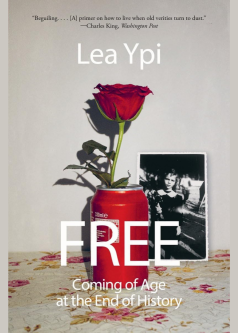
"Ypi is a prominent political philosopher and this year’s Dewey Lecturer in Law and Philosophy. Free is a riveting autobiography about growing up in communist Albania, perhaps the most repressive communist regime in the world. As a child (born in 1979), she believed it to be a utopia, a truly free country, although her parents were always strangely reticent about her enthusiasms (learned at school) for Stalin and 'Uncle Enver' Hoxha, the Albanian dictator. As the communist regime comes to an end in 1991-92, Ypi learns truths about her country and her own family that turn her world upside down, and change her understanding of freedom forever. A remarkable and engaging story!"
A Marriage at Sea by Sophie Elmhirst
Recommended by Saul Levmore, William B. Graham Distinguished Service Professor of Law

"A Marriage at Sea by Sophie Elmhirst is not just another book about the rescue of ship-wrecked people. You learn a great deal about survival but also about our inner selves and the kind of partnership that makes for a marriage."
Breakneck: China's Quest to Engineer the Future by Dan Wang
Recommended by Saul Levmore, William B. Graham Distinguished Service Professor of Law

"It’s a good book for beginning conversations about the comparison between the rise of China as a state governed by engineers and the US run by (is) its lawyers."
The River of Doubt by Candice Millard
Recommended by Saul Levmore, William B. Graham Distinguished Service Professor of Law

"The River of Doubt by Candice Miller lets you inspect a different side of Teddy Roosevelt while you learn about exploration, bravery, camaraderie, and the people of the (previously) untouched Amazon. As with other recommendations it’s a book of nonfiction that’s gripping because as you read it you can forget that it’s not fiction."
The Bell Jar by Slyvia Plath
Recommended by Jonathan Masur, John P. Wilson Professor of Law

"My recommendation is The Bell Jar, by Sylvia Plath, which I suspect many people have heard of but not necessarily read. (That was the case for me until this year). It’s famous as a terrifying and accurate portrayal of a young woman’s descent into severe mental illness, and it is certainly that. But it’s also an incisive and observant portrait of the situation that intelligent, educated women faced in the workforce during the late 1950s and early 1960s. The novel succeeds brilliantly as a critique of the ways in which opportunities were closed off to even the most capable women of the time. In fact, I recommend accompanying it with a viewing of Mad Men, which touches on many of the same themes."
The Silence of the Choir by Mohamed Mbougar Sarr
Recommended by Joan E. Neal, Professor from Practice

"Of all the books I read this past year, this one has stuck with me most strongly. The book is set in a small town in modern-day Sicily and tells the story of the townspeople after the arrival of a large group of African men. Some of the townspeople welcome the newcomers, while others do not – as evidenced by the many ways the townspeople refer to the newcomers (immigrants/refugees/migrants/exiles or simply, the guys) and engage with them. The story is told from many perspectives, including a priest, a doctor, an interpreter (who had once been in their shoes), a poet with writer’s block, a politician, some thugs, and of course the newcomers themselves. Things come to a head in the town, and not everyone survives the encounter. The prose is stunningly beautiful – there were sentences I read many times to savor them. Timely themes about recognizing oneself, recognizing others, recognizing the world we live in, and realizing how language can divide people."
All the Lovers in the Night by Mieko Kawakami
Recommended by Jennifer Nou, Ruth Wyatt Rosenson Professor of Law

"All the Lovers in the Night is about a copy editor navigating isolation and loneliness in bustling Tokyo. Her life has been one of inertia, punctuated by chance encounters that will help her to start seeing the world in a new light. But the arc of her journey is satisfyingly ambiguous. The book was somewhat of a slog at first, likely due to its first person telling and the protagonist’s sense of detachment and malaise. But I soon found myself pulled into this quiet story, immersed in another culture, and thinking about it long afterwards."
Small Things Like These by Claire Keegan
Recommended by Jennifer Nou, Ruth Wyatt Rosenson Professor of Law
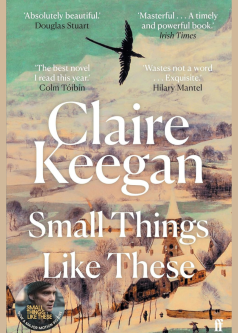
"Small Things Like These is a quietly powerful story about a coal merchant in Ireland faced with dark choices. While the book is set amidst the horrors of the Magdalene laundries, it is arguably a tale of the small acts taken by ordinary people amidst immense social pressure. Keegan tells this tale with spare and haunting prose. Highly recommend."
The Picture of Dorian Gray by Oscar Wilde
Recommended by Martha C. Nussbaum, Ernst Freund Distinguished Service Professor of Law and Ethics

"This January, Lyric Opera will be presenting Richard Strauss's opera Salome, based on Oscar Wilde's play. In writing the program essay for this opera (I hope you'll find it helpful!), I've read a lot of background material, but nothing more wonderful than Wilde's novel The Picture of Dorian Gray and especially his long letter written from prison (two years at hard labor for consensual sexual acts with adult males), entitled De Profundis.
Since I think the play and opera are about the horrible consequences of beauty and power with no moral accountability, it's good to be reminded that Wilde was not just the frothy comic playwright of The Importance of Being Earnest, but also a very serious anti-Victorian ethical thinker, who abhorred his society's use of cruelty and championed a Christianity of kindness."
Tangled Up in Blue: Policing the American City by Rosa Brooks
Recommended by John Rappaport, Professor of Law

"Georgetown law professor Rosa Brooks brings you along as she trains and then deploys as a sworn, armed reserve police officer in Washington, D.C. Writing with self-deprecating wit, Brooks — the daughter of immersion journalist Barbara Ehrenreich, who appears in the book — takes you behind the 'blue wall of silence' like few authors can. The resulting memoir challenges readers on all sides of policing’s complicated politics."
Dominion by Tom Holland
Recommended by Adriana Z. Robertson, Donald N. Pritzker Professor of Business Law
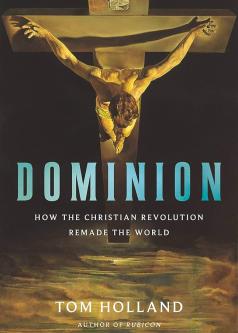
"In this sweeping intellectual history, Holland makes the case that many of the modern secular ideals that we take for granted—human equality, the dignity of the vulnerable, limits on power—are, in fact, Christian in origin. Regardless of your faith tradition, the intellectual genealogy is illuminating; it’s a tour of how our moral vocabulary developed, beginning in antiquity and continuing through to modern rights movements. In doing so, the book helps explain why arguments about justice, punishment, and freedom sound the way they do, both in the law and in everyday life. The narrative is brisk, clear, and consistently thought-provoking. Even where I wasn’t convinced, I learned something on nearly every page."
Let the Great World Spin by Colum McCann
Recommended by Alison Siegler, Lillian E. Kraemer Clinical Professor in Public Interest Law, Director of the Federal Criminal Justice Clinic

"One of the best books I’ve read all year, though it was published nearly two decades ago. McCann intricately weaves together a host of disparate and compelling characters who are united by a single act: the death-defying 1973 tightrope walk between the Twin Towers. The passage about the tightrope walk itself is so stomach-turningly nerve-racking that I had to hold the book at arms’ length and read with my eyes half shut! An arbitrary and vindictive criminal system plays a supporting (and not entirely satisfying) role, but overall, it’s a breathtaking read."
Justice Brennan: Liberal Champion by Seth Stern and Stephen Wermiel
Recommended by Geoffrey R. Stone, Edward H. Levi Distinguished Service Professor of Law

"I just finished reading Justice Brennan: Liberal Champion, by Seth Stern and Stephen Wermiel. It especially intrigued me because I served as a law clerk to Justice Brennan during the Court’s 1972 Term. The book was described by the Washington Post as 'Perhaps the best judicial biography ever written.' I have to agree. It offers incredibly detailed and insightful information about Brennan’s life and career, about how he got appointed to the Court by President Eisenhower, and about his extensive and often fascinating interactions with a broad range of fellow justices over the course of his thirty-five years on the Court. It offers a lively, engaging, and – especially in light of today’s Supreme Court – profoundly illuminating understanding of the Court in the Warren, Burger and Rehnquist eras. It reveals the critical ways in which justices from very different perspectives often worked together to find important common ground. We need more of that today."
Livesuit and The Mercy of the Gods by James S.A. Corey
Recommended by Lior J. Strahilevitz, Sidley Austin Professor of Law

"Corey is the pen name for two authors working together, Daniel Abraham and Ty Franck. They are well-known for their earlier series, The Expanse, which is the best science fiction series I’ve ever read. The Mercy of the Gods is the first novel in a new trilogy, and Livesuit is a short novella set at an earlier time in the same universe.
The Mercy of the Gods presents the story of a human civilization on another planet under attack from a terrifying and hierarchical alien species that is using advanced technology to try to dominate all intelligent life in the universe. While it takes some effort to keep track of all the characters and species assembled, and to understand the group dynamics, the book builds up steam throughout.
Then Livesuit, the haunting follow-up novella, packs an immediate emotional wallop and sheds significant light on The Mercy of the Gods’s backstory. The Expanse is a very tough act to follow, but the two books make a promising start."
Wave by Sonali Deraniyagala
Recommended by Erica Zunkel, Director of Clinical and Experiential Learning, Clinical Professor of Law, Director of the Criminal and Juvenile Justice Clinic

"One of my favorite books this year was Wave by Sonali Deraniyagala. This memoir recounts the author’s experience surviving the 2004 Indian Ocean tsunami, which claimed the lives of her husband, two young sons, and parents. It’s a beautiful and heartbreaking look at rebuilding a life after tragedy and surviving the unthinkable."