News


The United Nations Human Rights Council has appointed Anjli Parrin, associate clinical professor of law and director of the University of Chicago Law School’s Global Human Rights Clinic, to its Working Group on Enforced or Involuntary Disappearances.

Rodolfo Pavanelli Menezes, LL.M. ’27, took an unconventional path to the law. After earning a degree in physical education, he spent nearly a decade as a personal trainer before changing careers and entering law school at age 30.

Nefeli Megalovasili, LL.M. ’27, has taken an unconventional route from law school back to legal practice. After earning her LL.B.

Faculty in the News
“When the legislatures of Alabama, Arkansas, Louisiana, and Texas prescribed a particular form of the Ten Commandments for public school classrooms, the forms they chose provided theological answers to contested theological questions,” said the paper by Samuel L. Bray of the University of Chicago law school, Nathan S. Chapman of the University of Georgia law school, and Brent A. Strawn, a professor of law and the Old Testament at Duke University.

Craig Futterman, a clinical professor of law at the University of Chicago and one of the attorneys representing the coalition of community groups, noted how the Illinois Supreme Court in 2020 rejected a similar argument from the FOP when the union attempted to have misconduct records destroyed after five years.
“The Illinois Supreme Court said, ‘No, no, no, no, no, that violates fundamental public policy of the state and any collective bargaining agreement that is contrary to public policy is void and unenforceable,” Futterman told the Tribune.
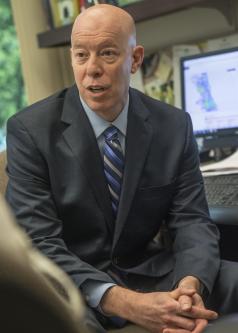
In a research paper posted last month, Nathan Chapman, a law professor at the University of Georgia, along with Samuel Bray of the University of Chicago and Brent Strawn of Duke, assessed the Texas law requiring all public elementary and secondary school classrooms in the state to display a poster or framed copy of the Ten Commandments and found it to be clearly unconstitutional, noted Adam Liptak, chief legal affairs correspondent of the New York Times.
The UChicago Experience
Events
—
Weymouth Kirkland Courtroom
—
Participating faculty: Adriana Z. Robertson, Adam Chilton
—
Participating faculty: Adam Chilton, Eric A. Posner