News

The Library of Congress announced on September 22 that Martha C. Nussbaum is the 2026 recipient of the John W. Kluge Prize for Achievement in the Study of Humanity.

Originally from Spartanburg, South Carolina, Grant A. Booker, ’29, comes to UChicago Law as an active-duty officer in the U.S. Marine Corps. A graduate of the United States Naval Academy, Booker was selected for the Marine Corps’ Funded Law Education Program and plans to serve as a Judge Advocate after law school.
There’s a moment Craig Futterman waits for at each year’s Intensive Trial Practice Workshop. It’s not a student learning how to make a polished closing argument or a confident cross-examination, nor is it how they learn to skillfully introduce evidence.
Among the new sessions at this year’s UChicago Law Orientation was “Notetaking 101,” designed to help 1Ls develop an essential law-school skill. Dean of Students Brandi Welch led the session, along with four upper-class student mentors, known as dean’s fellows: Malaysia Atwater, ’28, Raina Jain, ’28, Reed Caney, ’28, and Amira Abboud, ’28.
Hunter Strauss, ’29, brings a wide-ranging background to UChicago Law. A Georgia Tech graduate with degrees in biomedical and aerospace engineering, Strauss has served in the Army and Air Force and is currently a combat search and rescue pilot in the California Air National Guard.
Faculty in the News
Craig Futterman, a clinical professor of law at the University of Chicago and one of the attorneys representing the coalition of community groups, noted how the Illinois Supreme Court in 2020 rejected a similar argument from the FOP when the union attempted to have misconduct records destroyed after five years.
“The Illinois Supreme Court said, ‘No, no, no, no, no, that violates fundamental public policy of the state and any collective bargaining agreement that is contrary to public policy is void and unenforceable,” Futterman told the Tribune.
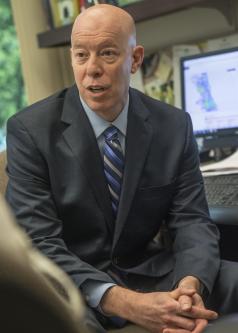
In a research paper posted last month, Nathan Chapman, a law professor at the University of Georgia, along with Samuel Bray of the University of Chicago and Brent Strawn of Duke, assessed the Texas law requiring all public elementary and secondary school classrooms in the state to display a poster or framed copy of the Ten Commandments and found it to be clearly unconstitutional, noted Adam Liptak, chief legal affairs correspondent of the New York Times.

America’s top law schools are figuring this out on the fly: for the new academic year, the University of Chicago Law School will ban phones, tablets and laptops from core first-year classrooms, so students cannot use technology shortcuts that “stunt intellectual growth."
The UChicago Experience
Events
—
Room V
Participating faculty: Tom Ginsburg
—
Weymouth Kirkland Courtroom