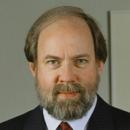
Judge Frank Easterbrook Awarded the 2026 Coase Medal for Outstanding Contributions to Law and Economics

Frank Easterbrook, ’73, a judge of the United States Court of Appeals for the Seventh Circuit and a former professor at the Law School, received the prestigious Coase Medal from the American Law and Economics Association (ALEA) on May 15.
Hosted at the Rubenstein Forum, the award ceremony included remarks from Lee Fennell, the Max Pam Professor of Law and president of the ALEA, Daniel Fischel, ’77, a former dean of the Law School and longtime friend and coauthor of Easterbrook, as well as a keynote address from Easterbrook.
One of the most influential figures in antitrust law and economic analysis of law, Easterbrook has shaped legal education and scholarship through his judicial opinions for more than four decades. He accepted the ALEA’s highest honor—named for the late Nobel Laureate, economist, and UChicago Law Professor Ronald Coase, before a packed room of law and economics scholars from around the country and globe.
Fennell opened the program by thanking the Coase Medal committee and welcoming attendees before introducing Fischel.

Fischel reflected on the influential scholarship of Easterbrook, with whom he coauthored the highly acclaimed 1996 book, The Economic Structure of Corporate Law. In his remarks, Fischel spotlighted three of the judge’s most seminal articles:
“Two Agency-Cost Explanations of Dividends,” which confronted the puzzling persistence of dividends by proposing that external capital markets act as efficient third-party monitors. The article, Fischel noted, echoed Coase’s insights that “third-party contracts are frequently a way to achieve the same objective” as internal governance mechanisms.
“The Limits of Antitrust,” which argued that courts, uncertain about market practices, should refrain from intervention and let market forces self-correct. “For things that you don’t understand, leave them alone,” said Fischel, summarizing Easterbrook’s philosophical approach.
“Cyberspace and the Law of the Horse,” written during the advent of the internet age, advocated for general legal principles rather than a patchwork of regulations for the internet. Easterbrook, Fischel noted, applied “Coasean” logic: efficient outcomes arise when property rights are well-defined and transaction costs are low. “There is no such thing as the law of the horse,” Fischel said, describing how Easterbrook urged legal scholars to focus on broad, consistent doctrines that could have broad scale application.
Fischel closed on a lighthearted note, saying he wanted to dispel “the scary Frank myth.” He called Easterbrook “a loyal and good friend who is generous with his time.”

In accepting his award, Easterbrook opened his remarks with a tribute to the medal’s namesake, Ronald Coase—whom he called his “mentor, teacher, colleague, friend, and intellectual hero.”
“He’s also the man to whom Dan [Fieschel] and I dedicated our book, The Economic Structure of Corporate Law,” he added.
Easterbrook recounted his early days at the Law School, attending seminars led by Coase and Richard A. Posner, another towering figure in the field—each approaching economic analysis of law from strikingly different perspectives.
“Posner was an economic imperialist who followed Gary Becker in thinking that economics could analyze anything… Coase, by contrast, firmly believed that economics is a way to analyze markets,” Easterbrook explained.
He traced the influence of UChicago’s Journal of Law & Economics—edited by Coase and then by Easterbrook many years later—which “analyzed the issues that ensue when law intervenes in explicit markets.”
The journal, Easterbrook explained, often demonstrated that misguided antitrust laws and regulatory interventions caused more problems than they solved. He recounted how Coase’s advocacy for property rights in radio spectrum opened the door to modern telecommunications. “Think of the rights that underlie the wonders in our pockets, the cell phones,” he said. He also related how the scholar’s insight that property rights are essential to make markets work paved the way for the creation of tradable fishing rights in Alaska—“cap and trade”—which transformed inefficiency into sustainable prosperity.

Still, Easterbrook noted: “[As much] as I would like to credit the Journal of Law and Economics with changing legal doctrine—I need to give credit to markets. Bad legal rules are simply expensive and when capital can go freely, money will travel toward better rules.” The competition among states in corporate law, he said, is a testament to the market-driven evolution of legal norms.
However, Easterbrook sounded a note of caution regarding tort law. Sharing candid anecdotes from his more than four decades on the bench, he lamented that despite the rise of economic reasoning elsewhere, tort law remains dominated by “moral language such as what is right and just.”
Lawyers and judges shy away from economic methodology, he observed. And competition, he suggested, is hampered by legislatures and courts who resist contractual or jurisdictional innovations that would inject market discipline into tort law.
And yet, Easterbrook noted that “both numbers and economics have come a long way since [his] seminars with Coase and Posner.” He urged the assembled scholars not to become pessimistic “just because the ‘Coase corollary’ dooms each of us to have a miniscule effect on society.”
“We can and should collectively maintain and establish the conditions of competition, including competition and legal doctrine, that may improve economic conditions for everybody,” he concluded.