An Advocate for the Most Vulnerable

When Emily Buss joined the Law School, she brought a decade of experience advocating for children’s rights in Baltimore and Philadelphia’s child welfare systems. Her years on the frontlines—representing at-risk youth and their families, navigating legal bureaucracies—shaped a perspective that continues to inform Buss’s work as a scholar, teacher, and mentor. Most potently, those experiences forged a lifelong commitment to listening deeply to those most affected by the law.
“Interacting with and hearing from young people has been essential to my work,” said Buss, who is the Mark and Barbara Fried Professor of Law. “It shapes how I think, what I write, and what I teach.”
A scholar of children’s and parents’ rights and the legal system that contains them, Buss’s research often interrogates systems and pushes at their boundaries, in part because she has seen how the legal rules play out in everyday situations. “To be a good scholar, I can’t be an advocate for a particular side,” she said. “But I can strive to build scholarship that practicing attorneys and judges can use, so that is what I aim to do.”
Buss’s philosophy of listening to and learning from those affected by the law came to the forefront in the Milwaukee Court Project. In 2015, she collaborated with a Milwaukee judge to rethink the juvenile justice system’s courtroom dynamics.
Traditional settings—benches, robes, a built-in hierarchy—send alienating signals to young people already feeling anxious and isolated. “We wanted the youth to feel like they were respected in the system,” Buss explained. So, they removed the formalities, held probation reviews as discussions, and even provided snacks.
The project brought together attorneys, judges, and probation officers to create this more developmentally appropriate environment in which the youth and their families, along with all these state actors, could engage in meaningful problem-solving throughout their period of probation.
At first, the juveniles held back. But as they relaxed, they slowly began to talk and enjoy the snacks, and their genuine personalities began to emerge. They even played the role of host to some of the less familiar adults in the room, greeting them warmly and offering to share the snacks, reflecting their sense of comfort and agency.
While snacks were hardly the most important aspect of the process, Buss reflected that food is a powerful communicator. “When there are snacks, there’s a kind of humanity in the room,” she said.
After the Milwaukee project, Buss launched the Constitutional Rights Seminar for incarcerated teens, initially taught online during the COVID-19 pandemic. UChicago Law students partnered directly with youth from five facilities across Illinois, exploring topics ranging from free speech to gun rights to abortion. In subsequent years, Buss offered the class in person, holding some sessions at a Chicago juvenile justice facility and some at the Law School. The serious intellectual engagement, in large and small groups, and in one-on-one sessions between the students and the youth, was transformative for all the parties involved.
“Our students are taught to debate ideas with us and with one another—but it’s a different experience to engage with someone who lives a very different life from you. It changed how the students thought about the issues,” said Buss.
Many youth entered the seminar with unexamined, often polarizing opinions. But the seminar’s respectful debates—driven by curiosity and often punctuated by laughter and disagreement—showed both the students and teenagers that it’s possible to care deeply and still engage productively across divides.
For the students, hearing firsthand accounts of stop-and-frisk reshaped their theoretical grasp of rights; it forced them to grapple with a gap between their “book learning” and the youths’ daily experiences. “You hope that what people get when they're learning law is not completely disconnected from the reality in which law plays out,” Buss noted.
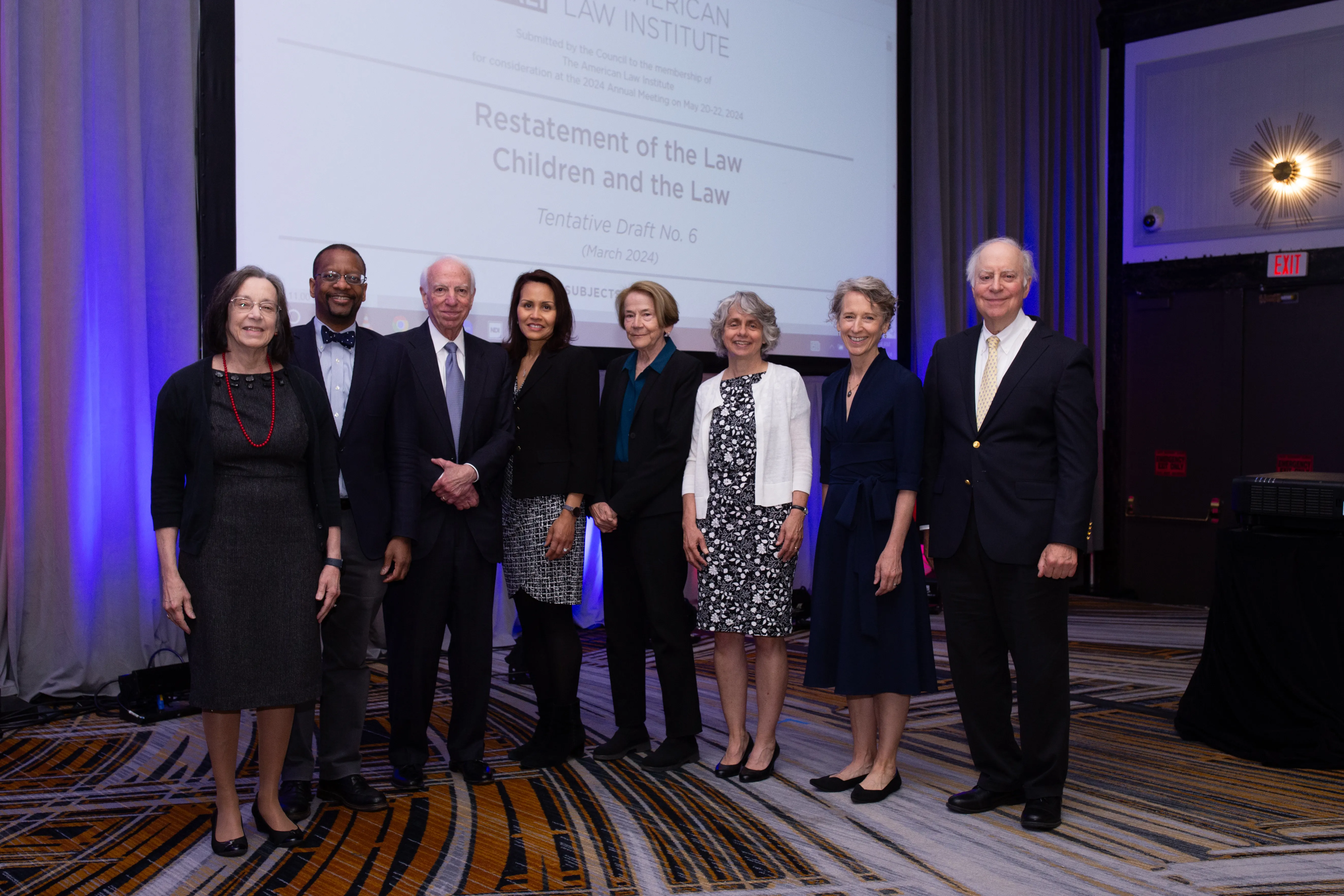
Outside the courtroom and classroom, Buss’s most significant contribution to her field might be her role in the American Law Institute’s 2024 Restatement on Children and the Law, the first comprehensive synthesis of children’s rights, needs, and obligations in American law. As an associate reporter, Buss helped shape a text that advances coherence across a patchwork of doctrines: criminal justice, family law, education, constitutional rights, and more.
“Our Restatement advances the law affecting children by drawing together several fields that have developed separately,” she explained. A core theme, child well-being, aligns areas that too often operate in silos. By applying developmental science and articulating underlying rationales, the Restatement offers judges support in deciding cases on a range of issues impacting children’s lives.
Drafted over nine years, the initiative convened judges, lawyers, scholars—and, crucially, law students, whose research and drafting made the multivolume project possible. On constitutional rights—including free speech for minors—Buss exercised particular care, knowing that rapid doctrinal changes could unsettle hard-won protections. The Restatement, she hopes, will help “preserve the protections the Supreme Court has already clearly established.”
Finally, in her latest venture, Buss is expanding her impact as faculty director of the Law School’s new Public Interest Leadership Program, which provides mentorship, structure, and community for students wanting to pursue public interest careers. Launching with an inaugural cohort of 24 students last fall, the program is a visible affirmation, Buss said, that “the Law School deeply values this work.”
“I am committed to supporting students doing public interest work. I know how rewarding and valuable the work is, and I know how challenging it is to pursue these careers when so much attention and support is focused on private sector ‘big law’ jobs,” she said.
“Lawyers always play a key role in darker times,” Buss added. “What may discourage our law students about the current state of the world also makes them indispensable. I want our students to know that they can use their law degrees to make a difference.”
For Buss, the Public Interest Leadership Program brings together the strands that have defined her career: listening deeply, leading with purpose, and making a tangible difference. Her new role also formalizes a commitment that she has long practiced—one rooted in the belief that careful lawyering can shape lives far beyond a single case.