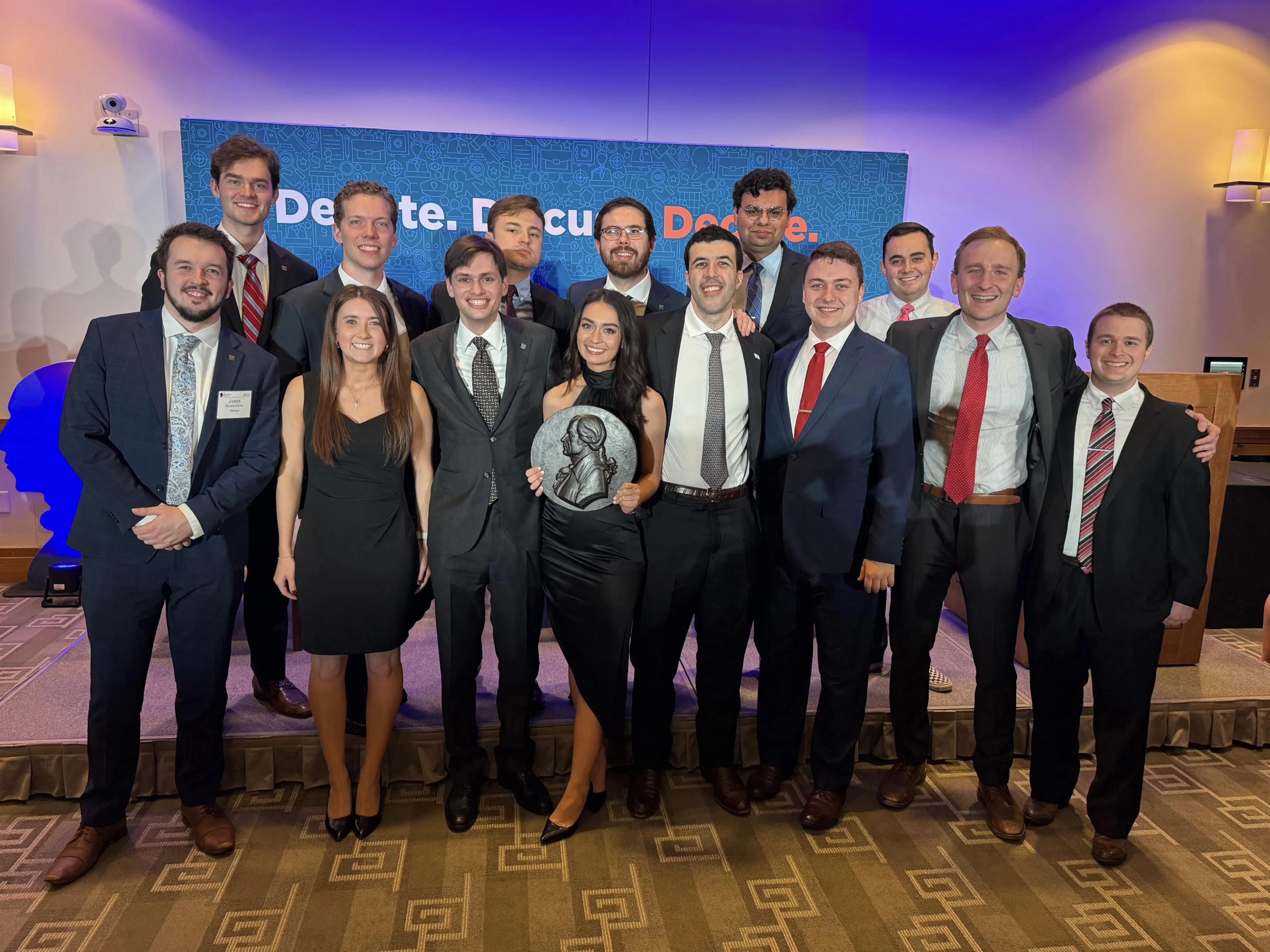
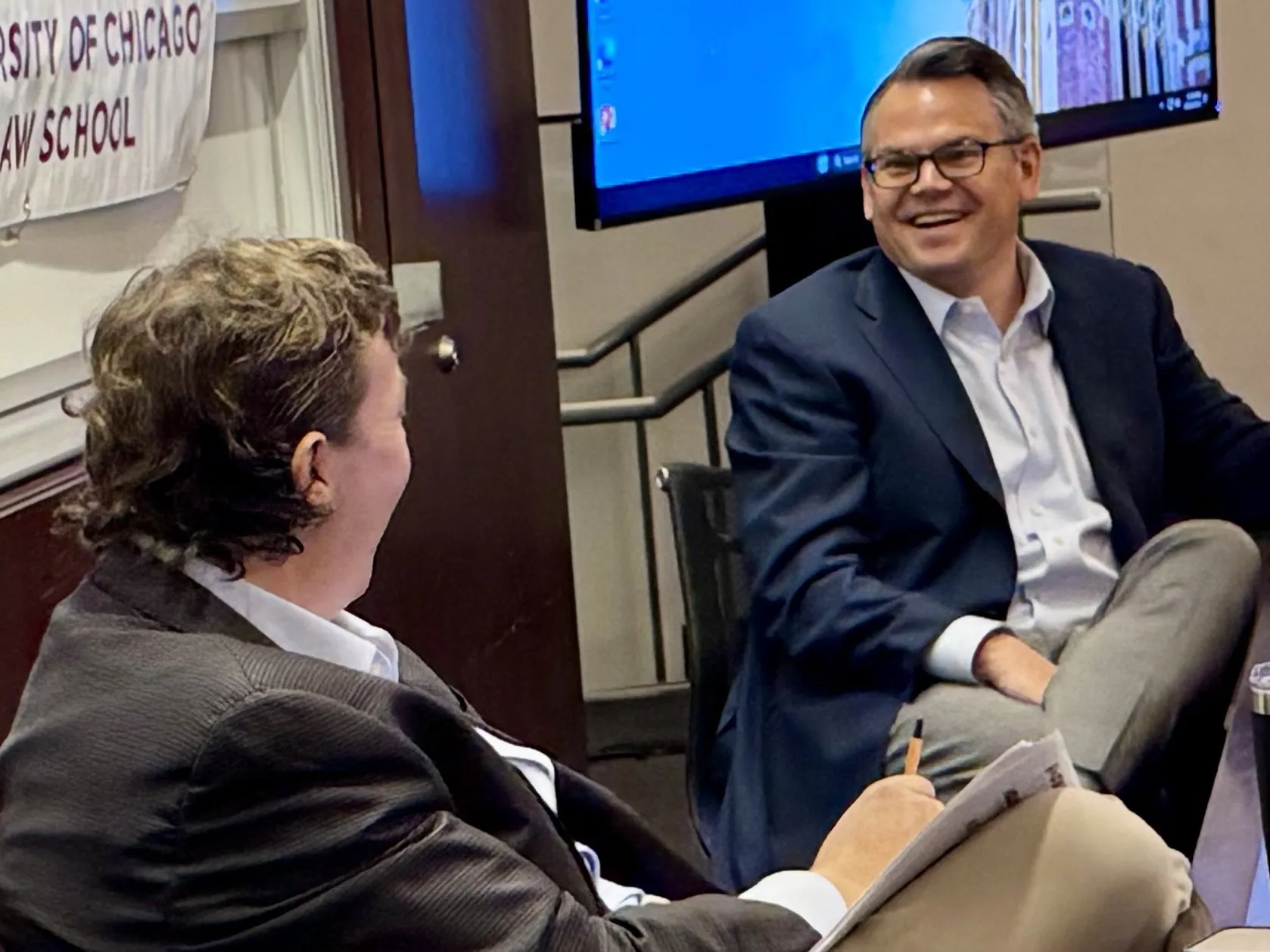
The Federalist Society at UChicago Law: A Hub for Debate and Intellectual Engagement

For more than four decades, the Federalist Society (FedSoc) at the University of Chicago Law School has played a visible role in campus intellectual life, convening students, scholars, judges, and practitioners together to debate fundamental questions about law, governance, and constitutional interpretation.
The late Justice Antonin Scalia helped organize the UChicago chapter in 1982, when he was a professor at the Law School. Since then, the chapter has remained grounded in the Law School’s longstanding commitment to free expression and serious engagement with competing ideas.

A Student-Driven Intellectual Community
For many students, involvement in FedSoc begins with curiosity about ideas and a desire to engage across differences.
“As a conservative law student, I chose to attend UChicago Law because of its culture of intellectual diversity and open exchange of ideas,” said chapter member Anastasia Dalianis,’27, who helps organize events. “I knew the Federalist Society played a large role in promoting this culture on campus, so joining felt like a natural fit.”
Dalianis describes the chapter as discussion oriented. “Through lunch talks, conversations with judges and guest speakers, and discussions with other students, I’m constantly learning and being challenged,” she shared. “We prioritize respectful engagement with each other’s ideas and those of our peers.”
That emphasis on dialogue is central to the chapter’s mission. Events are open to all students, and many are co-sponsored with other student organizations, reflecting a shared interest in debate rather than consensus.

Recent campus events have addressed topics ranging from Supreme Court jurisprudence and administrative law to banking regulation, constitutional family law, and workplace policy. Speakers have included judges, academics, and practitioners from across the legal spectrum, often paired with opportunities for student questions and discussion.
For Dalianis, who previously served as a 1L Representative and now helps lead programming, that behind-the-scenes work has been especially rewarding. “I enjoy coordinating with speakers and introducing them at events,” she said. “It’s been great public-speaking experience, and it’s taught me a lot about organizing professional conversations.”
A Commitment to the “Marketplace of Ideas”
Collin Mitchell, ’26, current president, sees the chapter as an extension of the Law School’s core educational values.
“I was drawn to the Federalist Society because of its commitment to the ‘marketplace of ideas,’” Mitchell explained. “At UChicago, we’re taught to question everything. FedSoc provides a forum for debating first principles—like textualism, originalism, and the structure of government—in a serious way.”

Leading a politically affiliated student group in a diverse academic environment comes with challenges, Mitchell acknowledged. “The biggest challenge is avoiding the echo chamber effect,” he said. “Our goal is to create a space where people can disagree without being disagreeable.”
He sees that work as essential preparation for the legal profession. “Law is adversarial by nature,” Mitchell noted. “If you never engage with viewpoints you disagree with, you won’t fully understand your own. Diversity of thought isn’t just a social value—it’s part of training better lawyers.”
Looking ahead, Mitchell hopes the chapter will continue expanding its collaborative formats. “Some of our most successful events are co-sponsored with groups across the aisle,” he said. “My hope is that the Federalist Society remains a hub for cross-partisan dialogue—where students can argue rigorously and then grab a coffee afterward.”

Coming up This Month
Both Mitchell and Dalianis point to upcoming events that exemplify the chapter’s emphasis on substantive engagement, including a live recording of the Divided Argument podcast hosted by Professor William Baude and Daniel Epps (Washington University in St. Louis School of Law) on Wednesday, March 4.
Other FedSoc events coming up in March include:
March 5, 2026: Sheldon Gilbert and Rachel Brand
March 24, 2026: Willie Soon
March 27, 2026: “DExit” Panel