Free Expression in Higher Education: A Q&A with Tom Ginsburg
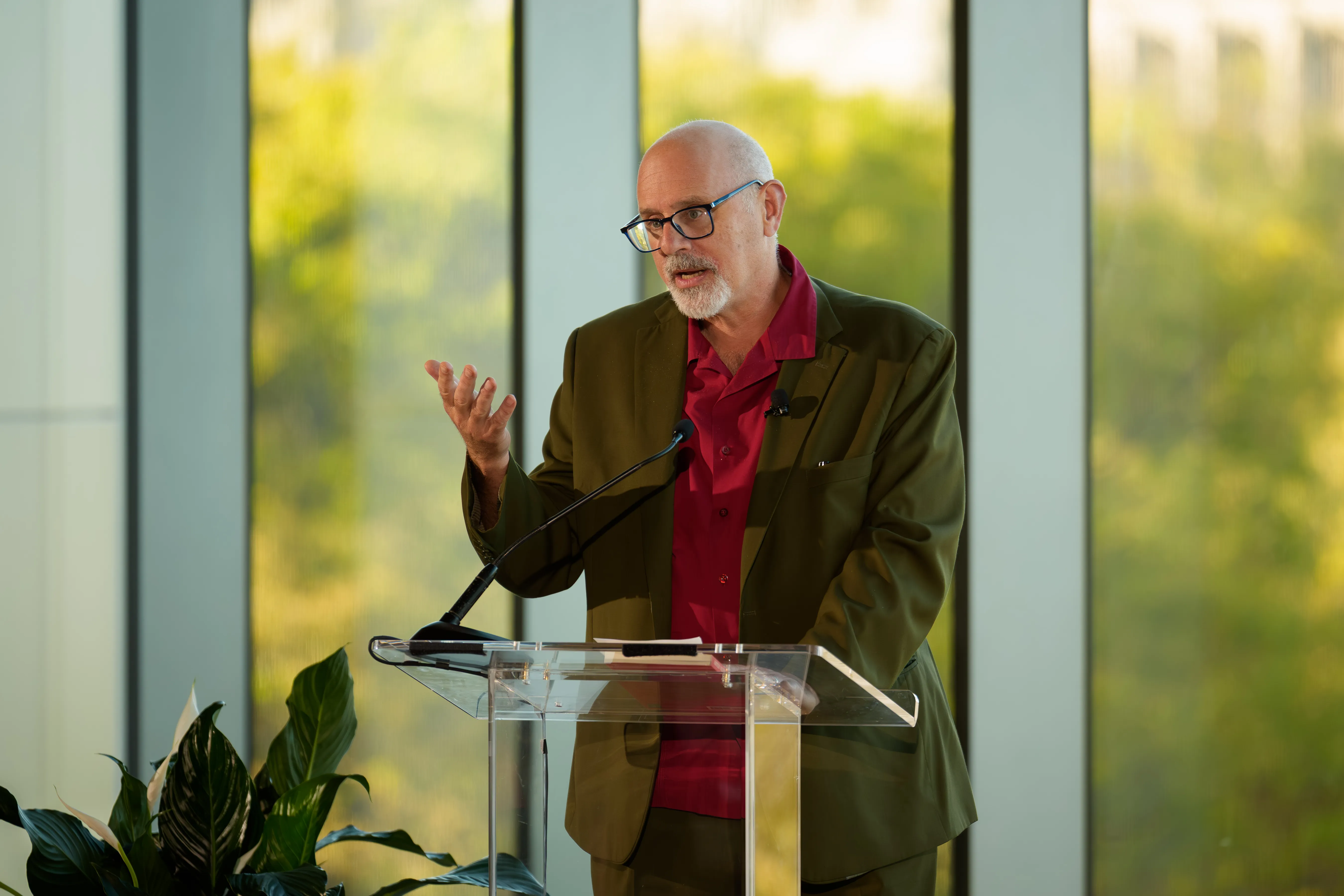
The ongoing debate about free expression in higher education has grown increasingly complex and contentious in recent years, shaped by a variety of societal and political factors that are continuously evolving. In a recent Q&A with the Law School, Professor Tom Ginsburg, faculty director of the University of Chicago Forum for Free Inquiry and Expression, offers valuable insights into why freedom of expression is vital for higher education—and for society as a whole—to thrive.
Ginsburg is the Leo Spitz Distinguished Service Professor of International Law, the Ludwig and Hilde Wolf Research Scholar, a professor of political science, and in addition to the Chicago Forum, he leads the Law School’s Malyi Center for the Study of Institutional and Legal Integrity.
Why has the issue of free inquiry become such a flashpoint in higher education?
I think there have always been tensions around free inquiry, but they have really come to the forefront in the social media era. Social media has led to minor episodes going viral and creating moral panics. There is a general phenomenon of self-censorship as people fear cancellation. You have some fringe practices, like lists of discouraged words, that have come to shape the public perception of universities. In addition, there is a perception that faculties have shifted leftward, leading to complaints from the political right that speech is being restrained. People like Charlie Kirk amplified this theme.
Another trend of the social media era has been the idea that everyone needs to speak about everything. This has led to an unfortunate development, from my perspective, in that departments and disciplines hold themselves as authoritative speakers about issues of justice. When they do that, they are discouraging dissenters from speaking out. So, there are a lot of cross-cutting trends that have created the perfect storm for campus speech.
What makes academic freedom distinct from general free speech rights under the First Amendment?
They are quite different, although their purposes may overlap. Free speech is generally justified by three broad rationales: advancing individual autonomy; ensuring democratic deliberation; and the pursuit of truth. Only the latter is a justification in the academic context. This leads to differences in the scope of the concepts.
Academic speech is more limited because it is bounded by the search for truth. Most obviously, lying is generally protected by the First Amendment, but not by academic freedom. Academic freedom also is limited by scientific communities in which we are a part. I can teach constitutional law however I want to, but I cannot teach other material in my constitutional law class. If I insisted on teaching the laws of physics, I could be fired, and that would not be a violation of academic freedom.
You’ve written extensively on constitutional design and the rule of law. How do those frameworks inform how we think about free inquiry and expression within universities?
I think of free inquiry as the cardinal virtue of universities, and it has a constitutional role—it structures how we organize our institutions and regulate our practices. One cannot make progress on ideas without a willingness to challenge each other, and so free expression is essential to keep scholarly communities vibrant. Our University has some foundational documents, like the Chicago Principles, which serve to structure our speech environment, just like constitutional rules structure politics.
Another constitutional set of rules, at our university at least, are those laying out the idea of institutional neutrality as embodied in the Kalven Report (which likens an institution taking a collective position to censorship of those who disagree with that position). In working on The Chicago Canon on Free Inquiry and Expression, we learned that these ideals date back to the beginning of the University. William Rainey Harper adopted the rule that the University, as such, would not take positions on the issue of the day. He thought this was the best way to ensure the widest possible freedom of inquiry for the faculty and students. That has been an enduring idea and continues to guide our leaders today. Not every university has this idea; others have different constitutional values. For us, at least, this idea is central.
What responsibilities do universities—and especially law schools—have in safeguarding open debate, even when ideas are unpopular or controversial?
It is absolutely central. There are many forces in society discouraging open discussion of controversial ideas. So, our role is not just to safeguard debate, but to actively structure opportunities to engage in it. This is something we try to do at the Forum for Free Inquiry and Expression. The duty is especially important in law schools. When they enter practice, our students are going to have to defend positions that they do not personally agree with. They need to develop the muscles to do that, and there is no better way to do so than to talk to people they disagree with.
How should universities navigate the tension between protecting expression and maintaining community standards against harassment or discrimination?
Harassment has no place in a university. But it is also unrelated to the vigorous discussion of ideas. Insulting someone on the basis of race and gender doesn’t advance genuine conversation. We should construct an environment in which that never happens.
One of my senior colleagues once said we try to be tough on ideas and kind to people. I’ve used that a lot when I talk about free expression out in the world.
How can law schools model civil discourse and viewpoint diversity for the broader campus or society?
At our best, we can show people that open disagreement is not to be feared. Not only that, but it is also essential to advancing thought and justice. Judging requires being open to hearing new arguments and changing one’s mind on the basis of new evidence. This judicial virtue is also a general intellectual one. If our students can absorb and model this, they will bring it to their workplaces and to society more broadly.
In the two years since its launch, the University of Chicago Forum for Free Inquiry and Expression has been very active in its programming. What have you learned from these last two years of the Forum?
The basic idea reflects what I have said above: Free expression doesn’t just happen on its own but requires active efforts to structure environments in which it can occur. We have done a lot of different things through the Forum. Besides putting on events, we have tried to extend free expression orientations (which started here in the Law School under former dean Tom Miles’ tenure) to the rest of the institution. We have distributed research money within the University and have put on academic freedom institutes for administrators and faculty from other schools. I think our greatest success has been empowering our students to make their own choices about events and topics. When you empower students, good things happen.
What gives you optimism about the future of free inquiry in higher education?
Perhaps it is just the University of Chicago, but our students select this place because they want to engage. There is a hunger for dialogue and conversation here. Nationally, I think the tide is turning against repression. The growing awareness of the challenges of social media is generating a more conscious effort to use these tools responsibly.
How might the next generation of lawyers—trained in environments that prize rigorous debate—shape the national conversation on free expression?
There are huge issues that I cannot begin to understand, involving misinformation, technology, social media. How a free society grapples with the challenges these pose to free inquiry and expression is going to require a lot of work. That will be the product of many minds, including people who are both digital natives and committed to open discourse. I hope it is our students who will lead the way.