Federal Criminal Justice Clinic—Significant Achievements for 2024-25
The Federal Criminal Justice Clinic is the nation’s first legal clinic devoted to representing low-income clients charged with federal felonies. This year, we pursued national systemic reform projects aimed at reducing both pretrial incarceration and post-conviction imprisonment, and we also represented individual clients in a variety of federal criminal cases. Professor Alison Siegler, the Clinic’s Founding Director, and Professor Judith Miller work together with students to advocate in these areas. Below are the Clinic's significant achievements for 2024-25.
Freedom Denied Systemic Reform Project
Students working with Professor Siegler on the FCJC’s Freedom Denied Project have continued to drive systemic change nationally in the area of federal pretrial jailing and detention, building on the Clinic’s study, Freedom Denied: How the Culture of Detention Created a Federal Jailing Crisis (2022). In this report, the FCJC identified a federal jailing crisis and presented clear data to judges and other stakeholders about how federal bail practices routinely violate the law and people’s rights.
In the ensuing years, the FCJC has pulled every possible lever to address this crisis, resulting in nationwide progress. In response to our findings, judges around the country are writing pretrial release opinions that follow the requirements of the Bail Reform Act and advance the rule of law. See, e.g., United States v. Subil, 2023 WL 3866709, at *4 (W.D. Wash. June 7, 2023) (“A recent study of federal pretrial detention identifies just such a ‘problematic feedback loop’: ‘[T]he prosecutor requests pretrial detention for reasons not authorized by the law, the defense attorney does not object, and the judge neither questions the prosecutor nor adheres to the statutory requirements, sometimes jailing people unlawfully.’”) (quoting the FCJC’s Freedom Denied study at 29); United States v. McLean, 749 F. Supp. 3d 167, 169 (D.D.C. 2024) (discussing Freedom Denied’s findings).
Our Clinic is seen as a national leader on federal pretrial release, presenting trainings, speeches, and workshops for federal judges, public defenders, and other stakeholders. For example, Professor Siegler spoke on a panel at the Tenth Circuit Judicial Conference that was structured around our Freedom Denied study; co-ran a multi-day national bail workshop for Federal Public Defenders with assistance from Professor Miller; and presented a national webinar about how to leverage the Pretrial Risk Assessment instrument in litigating for release (attended by approximately 500 federal criminal defense attorneys). Professor Siegler also serves annually as the editor of the Bail Chapter of the Georgetown Annual Review of Criminal Procedure, which she and FCJC students have extensively revised to reflect the Bail Reform Act’s exacting legal standards.
In response to the FCJC’s study, federal judges asked the Administrative Office of the U.S. Courts to revise the Order of Detention Pending Trial form to incorporate our approach to the Bail Reform Act. The AO agreed, inserting an entirely new section into AO Form 472 called “Eligibility for Detention” that requires judges to document the particular statutory factor they are relying on before detaining anyone charged with a federal crime. Compare AO Form 472 (rev. 2025) with AO Form 472 (rev. 2016). Going forward, this change will help ensure adherence to the rule of law for the approximately 65,000 people charged every year in the federal system.
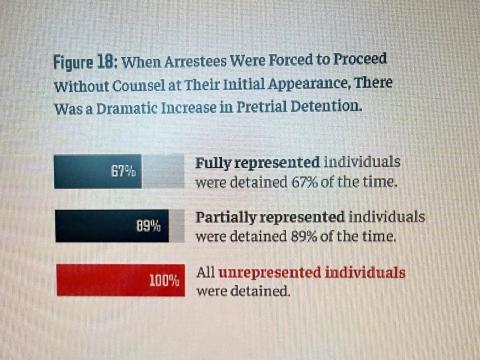
One major problem our study uncovered was that federal magistrate judges throughout the country were jailing people at their first bail hearing without a lawyer by their side. Specifically, our investigation revealed that in one-quarter of the 94 federal courts, a defendant could be jailed without counsel at their Initial Appearance hearing. This is a clear violation of federal law. Not surprisingly, we discovered that lack of counsel increases pretrial detention rates: every single unrepresented individual in our study was jailed at their Initial Appearance hea ring. See Freedom Denied at 135 & fig.18:
Since our study was released, the FCJC has been alerting leaders at the highest levels of the government and the judiciary to this access-to-counsel crisis, and we have brought about widespread change. At our urging, the Department of Justice added a section to their Justice Manual requiring prosecutors to recognize the right to counsel at Initial Appearance hearings, and the Judicial Conference of the United States issued a nationwide directive called Right to Counsel at Initial Appearance. Judicial Conference leaders also presented our data to the Chief Judges of the U.S. Courts of Appeals. And the 2025 edition of the Benchbook for U.S. District Court Judges includes an entirely new section about the right to counsel at Initial Appearance hearings.
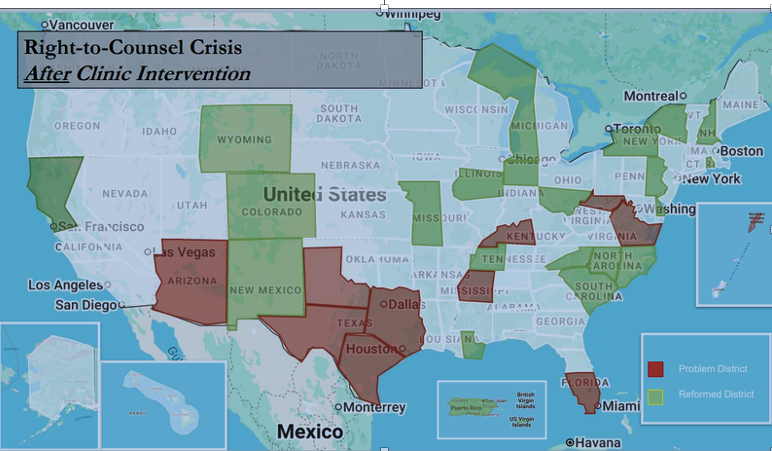
These interventions have resulted in concrete change. In 2022, the FCJC documented an access-to-counsel problem in 26 federal courts. Since then, 15 of those courts have addressed the problem and now ensure near-universal access-to-counsel at Initial Appearance hearings. The FCJC is leading additional interventions for the courts where the problem persists, including working closely with members of Congress who want to help rectify this crisis.sss
Federal Drug Sentencing Guidelines Reform Project
This year, the FCJC also helped lead federal drug sentencing reform. In fall 2024, the U.S. Sentencing Commission invited Professor Siegler and other sentencing scholars, federal judges, and practitioners to meet with them in Washington, D.C. for a day-long roundtable on the drug sentencing Guidelines. Along with a team of students, Professor Siegler conceived a new vision for the drug guidelines. We proposed that the Commission fundamentally change the Guidelines by calibrating sentences to a person’s function in a trafficking enterprise, rather than continuing to use the flawed metric of drug quantity to set sentences. Our proposal seemed to resonate with the Commission, as they initially proposed an amendment creating a new “low-level trafficking functions” adjustment.
In winter and spring 2025, our team wrote three public submissions to the Commission, all of which have been published as part of the 2025 amendment cycle: a Public Comment and a Public Reply Comment supporting the proposed amendments and suggesting additional revisions to the drug Guidelines, as well as a Public Comment urging the Commission to make any new amendments retroactive. Throughout this intensive project, the student team developed deep expertise on myriad sentencing issues.
Federal Sentencing Guidelines Retroactivity Project
Students working with Professor Miller have engaged in multiple rounds of advocacy before the Sentencing Commission to advance its “Simplification” project. The student team submitted a Public Comment and Public Reply Comment asking the Commission to change its sentencing recommendations for individuals who are also subject to another term of imprisonment, and to fix its binding policy for how those sentence reductions can be incorporated into retroactive sentence reductions. The Commission accepted a couple of the Clinic’s recommendations and has taken up another Clinic suggestion as a “proposed priority” for the upcoming 2025–2026 amendment cycle. Professor Miller and the student team are currently preparing a Public Comment responding to that proposed priority and asking the Commission to expand retroactive sentence reductions more generally. The underlying legal issues are highly technical and affect hundreds, if not thousands, of individuals.
The Retroactivity Project began in the 2023–2024 academic year, when FCJC student teams represented 4 incarcerated clients in motions to have their sentences reduced under the newly passed Amendment 821 to the Sentencing Guidelines. The Commission had issued this retroactive Amendment based on new data showing that two components of the Guidelines overstated certain individuals’ risk of recidivism. Under this Amendment, incarcerated individuals could ask the court to reduce their sentences. Three of the FCJC’s four sentence reduction motions have already succeeded.
Our fourth motion is still pending and rests on a circuit split that turns on two technical legal issues—both of which the FCJC has raised in our Public Comments to the Commission. First, Guideline § 5G1.3 contains a notoriously confusing set of rules for crediting time served on a related term of imprisonment. Second, the circuits are divided over whether retroactive sentence reductions such as Amendment 821 should include § 5G1.3’s credit for time served. In response to the Commission’s efforts to simplify the Guidelines, the 2024–2025 student team proposed revising § 5G1.3 to broaden access to certain sentence reductions and to address the circuit split by ensuring that sentence reductions include credit for time served. After adopting some of the FCJC’s suggestions for revising § 5G1.3, the Commission is now seeking suggestions for additional ways of simplifying the Guidelines. In response, the FCJC team plans to submit additional Public Comments in July 2025.
Jury Instructions Project
Building on objections from an earlier trial case, another student team submitted a lengthy letter to the Seventh Circuit Jury Instruction Committee asking for revisions to the so-called “Joint Venture” jury instruction. Under Professor Miller’s supervision, the team argued that the pattern instruction misstates the law and undermines the government’s burden. None of the other circuits’ pattern instructions suggest a stand-alone joint venture instruction. After extensive research, the team asked the Committee to follow the example set by other circuits, which is also supported by Seventh Circuit case law: either eliminate the instruction entirely or, in the alternative, incorporate it into the aiding and abetting instruction. The team’s request is currently pending.
Developing this proposal required the team to integrate multiple advocacy approaches. Students did a deep dive into the intricate legal questions underpinning the law of aiding and abetting, and then they transformed that research into persuasive advocacy before an administrative committee. To address practical drafting questions, the students also reviewed social science research about writing effective jury instructions. This Project built on the FCJC’s earlier success advocating for a revised “deliberate avoidance” jury instruction, also known as an “ostrich” instruction, under Professor Siegler’s supervision.
Individual Client Representation
FCJC students zealously represented several individual clients charged in complex federal criminal cases.
One student team under Professor Siegler’s supervision represented a client charged with gun possession. The students wrote 45 pages of motions and filed hundreds of pages of exhibits requesting a below-Guidelines sentence given the serious violence our client had experienced as a child; his need to receive treatment for trauma, mental illness, and addiction; and his loving support for a disabled family member. The students tied each of these factual issues to various factors in the sentencing statute, 18 U.S.C. § 3553(a). This case also presented a very complicated set of legal issues under the federal Sentencing Guidelines, because the state had indicted our client for offenses arising out of the exact same incident. There was also a question of how our client’s prior record should affect his sentence, with the Probation Office requesting a higher sentence. Thanks to the team’s persuasive legal arguments, the U.S. Attorney’s Office ultimately agreed with our position on both Guideline questions, a rarity. At the sentencing hearing, two 3Ls presented oral argument before U.S. District Judge Sara Ellis. During that hearing, the prosecutor commented that he had never seen as strong a release plan as the one this team had proposed. The judge ultimately rejected the prosecutor’s request for a 51-month sentence, consigning our client to just 17 months of incarceration. This case was co-counseled with former Federal Defender Matthew J. Madden.
Another student team under Professor Siegler’s supervision represented a client charged in a complex federal fraud case. The students filed three separate sentencing motions totaling 55 pages, as well as extensive exhibits. One motion raised a fact-intensive legal challenge to the economic loss amount driving our client’s high Guidelines range and required the team to synthesize thousands of pages of discovery. We also worked with a mitigation specialist, who wrote a report contextualizing the offense and conveying that our client had deviated from his lifelong, law-abiding path under financial pressure linked to childhood trauma. The students detailed how the collateral consequences our client had already faced weighed in favor of leniency under the statutory sentencing factors. They also presented a creative argument that a reduced sentence was necessary to avoid creating unwarranted disparities with our client’s co-defendants and others, presenting data that over 40% of fraud clients in the Seventh Circuit receive below-Guidelines sentences. Three just-graduated 3Ls presented extensive argument in the two-hour sentencing hearing before U.S. District Judge Lindsay Jenkins. The team’s brilliant argument convinced the judge that what the government contended was a single fraud scheme was actually two separate schemes, and that our client bore responsibility for only one. This reduced his Guidelines range significantly. As a result of the students’ forceful advocacy, our client is spending 9 months behind bars rather than the more than 3 years in prison requested by the prosecutor. Matthew Madden was our co-counsel on this case as well.
A third student team represents a client in a federal bank robbery case under the supervision of Professor Miller. Four FCJC students met our client in the lockup just hours after his arrest and jumped into action, interviewing family members and creating a release plan with the assistance of former Clinic social worker Lindsay Perlmutter. The students drafted a compelling 13-page motion requesting pretrial release based on our client’s extraordinary family ties, ongoing employment, and limited criminal history. After a hard-fought detention hearing that lasted for nearly two hours, a 3L student persuaded Magistrate Judge Jeffrey Gilbert to release our client, an extraordinarily rare result in this kind of case. This team has since filed over 80 pages of briefing arguing that our client’s post-arrest statements should be suppressed and the indictment dismissed. Our motions to dismiss include an entirely novel argument about a legal flaw in the indictment, and they also raise an issue of first impression in the Seventh Circuit. Both arguments ask the court to take a textualist approach to the elements of an offense, following recent Supreme Court and Seventh Circuit precedent. The motions are pending, and the case is currently heading toward trial.
Litigating Originalism
Professor Miller’s new seminar, Litigating Originalism, grew out of a Clinic-related question: how might the Clinic’s district court advocacy incorporate “originalist” methods? Professor Miller teamed up with Professor William Baude to teach a seminar about how litigators can use originalist arguments in court. The seminar intentionally included students with a wide variety of political and legal commitments and set aside questions about originalism’s validity and ideology. The University recognized the seminar’s important contribution by honoring Professors Miller and Baude with the faculty Diversity Leadership Award for the 2024–25 academic year. FCJC students enrolled in the class and were critical to its success.

Alison Siegler
Lillian E. Kraemer Clinical Professor in Public Interest Law, Director of the Federal Criminal Justice Clinic